While I’m sure there are people too lazy to spin a fork, keep in mind people like this person who may be suffering from arthritis or a neurological disease or nerve damage or a thousand other conditions that might impair their ability to do things as simple as spin a fork to eat spaghetti.
These are used with people who can’t grip well:
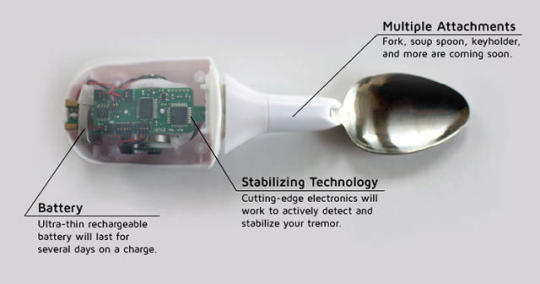
This is for Parkinsons’s:
For people who can’t even bend their joints:
Here’s a product that guides your hand from your plate to your mouth
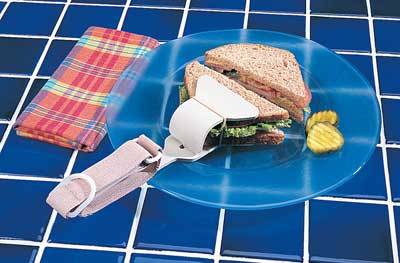
This one holds a sandwich
Like I get it. I used to see things like the fork and think “that’s fuckin’ lazy” or that product that holds a gallon and you just tip it and pour. But then I started working around the disabled and impaired and found out that these products aren’t meant for lazy people, they’re meant for people who need help.
So maybe next time you see something, instead of thinking “Wow, are people that lazy?” just be grateful that you’re able to do the things you do every day and take for granted, like being able to feed yourself and wipe your own ass because you have enough coordination and bendy joints to do it.
This isn’t specualtion either; the majority of products from commericals that we think are funny or silly are autally MEANT for hte disabled.But they are marketed towards the abled because the disabled aren’t considered a viable enough demographic on their own.
the Snuggie for example? Created for wheelchair users.
This is actually really nifty.
oh my god of course the snuggie was for wheelchair users
The fact that anyone buys these products besides disabled people drastically lowers the price of them. These would normally cost hundreds if not thousands if dollars. Because if spent time and money creating it, the company wants to get more than that back. And they can’t do that if they sell and market these primarily to disabled people for $20-$40 a piece or whatever. They’d lose money on production. If they can sell hundreds of them to everyone, they can lower the price drastically and therefore disabled people don’t die while trying to scrape up the money to buy these things and be a bit more independent.
I never considered that last part and that’s actually genius
Like yeah, a handful of people ARE that lazy.
But those are the people who use these products even though they don’t need them and thus allow the price to be lower for those who DO.
So honestly in this case good bless the lazy and those prone to gimmicks because they are invaluable to the elderly and disabled in this sense.
@thebibliosphere Look! People learning about disability and why to be kind!
The normalization of disability aids needs to be a thing precisely so they can cost less.
I keep seeing people, especially older adults, claim that if you have “ADD”, you don’t have hyperactive symptoms or that you grow out of it, which is just not true.
“ADD” or ADHD-PI as its now called, just means you have much more inattentive symptoms than hyperactive (hence, PI: Predominantly Inattentive).
I like imagining ADHD as a spectrum, with PH on one side, PI on the other and C in the middle. For example, I’m diagnosed as PI but I still show hyperactive symptoms from time to time; I once threw a towel, down the stairs, at my sister’s friend because I was feeling quite hyper.
Hyperactive symptoms don’t have to be physical, they can be mental too, like racing thoughts.
I’ve been diagnosed with ADHD-PI recently and I don’t experience physical hyperactivity at all. But in my head it is quite busy indeed. I talked to my roommate the other day and she said she sometimes doesn’t have any thought at all. Like I didn’t know that was possible. Mean well there isn’t a moment I’m not thinking about at least five things at the same time.
The constant buzzing of thoughts is the reason we need background music/noise to concentrate.. to drown out the buzz. I can’t study in a library because its too quiet.. and my in contrast my thoughts are too loud.
Talking a lot is a hyperactive symptom, the leg bounce is hyperactivity, feeling restless is a hyperactive symptom. How often do PI types exhibit symptoms like this? Every day for hours on end.
The idea that someone isn’t hyperactive because their hyperactivity isn’t loud and in your face to strangers is a problem.
And ADHD is lifelong. During each life stage, or even day to day, different things effect us and we learn new coping mechanisms as we go along (good or bad) so the disorder can display really differently in one single ADHDer. It’s all still ADHD and it’s all a challenge.
Also, physical hyperactivity symptoms in kids often get internalized as they get older. So they might seem to “grow out of it,” but really their brain has just matured just enough that they can be okay bouncing their leg instead of climbing on the furniture, or that they can usually control the constant impulse to interrupt people but it’s still there and something they’re very aware of and have to consciously hold back.
I do not appear to be anywhere even close to hyperactive. I was inactive as a kid, I’m inactive as an adult. Yet I have four of the required six hyperactive/impulsive symptoms.
One of the best ways to support Making Queer History is to become a patron, but we know that isn’t possible for a lot of folks in our community. And so, here are some of the best, non-financial ways to support queer history:
okay, most of what i do re: harry potter is criticism, and hp is flawed in such a number of ways, but sometimes i just sit here and
i mean, you all have a comprehension of just how drastically harry potter changed literature, yeah? like. it revitalized it. it blew the literary scene apart. the new york times had to create a separate bestseller’s list for children’s lit just because harry potter existed. harry potter changed reading.
so many people on tumblr were born in the ‘90s. when the first book came out, most of us couldn’t read. but we grew up in a world where everyone, everyone, everyone was reading harry potter, no matter how old they were; we grew up in a world where the most popular story in the entire world was a fantasy children’s book.
it’s sort of difficult to grasp, sometimes, the extent to which harry potter is not just a book. the extent to which what is basically a series of fun, interesting, and fairly good novels is such an enormous, enormous part of our lives, a cultural touchstone, a truly universal reference point, something so many people have shaped their lives around, a foundation for all of the stories we would read and watch for the rest of our lives– for so many of us, the first books we ever loved
the extent to which so many of us can’t call ourselves “fans” of harry potter, because it would like being a “fan” of, like, having lungs.
it’s not even about liking it or disliking it. it’s just a part of us.
This reminds me an awful lot about Starbucks.
No, seriously. Before Starbucks, America was a coffee wasteland. Coffee was a thing you got at diners and drivethroughs. It was a cheap hot thing you put made palatable with tons of cream and sugar, and most people (but waning!) had a coffee machine at home.
Starbucks told us that we could like coffee. That coffee could be an enjoyable thing, that it could be a status symbol and a ritual. That there could be a place where you go for coffee, and you enjoy it.
As a coffee snob, I think Starbucks’ coffee is awful. But Starbucks is why we have better coffee. Starbucks created the market space for third wave coffee shops and artisanal roasters. They reintroduced “espresso”, “latte” and “cappuccino” to the American lexicon.
We need stuff that’s heinously popular. That’s how culture works.
the fucked up thing about the salvation army is that theyre arguably the most visible and prominent hate group in america, but you cant hastle them or even protest them because to everyone else it would look like youre curb stomping santa clsuse
Not just for wheelchairs, but for crutches and canes too. I can’t count how many times I’ve fallen in snow, slipped on ice, or soaked my sleeves while trying to wheel in it. Please remember those of us who use mobility aids in the winter. Clear snow and ice. Mop up water on the floor immediately. Use rock salt on slippery porches and stairs/ramps.
THIS GIFSET ISNT WORKING. SOMEONE KEEP ME FROM DELETING EVERYTHING IN FRUSTRATION.
So one of the most frequent questions I get, is how do I work at a computer all day and avoid eyestrain, which is something people with chronic fatigue can be especially susceptible to, especially given our sensitivity to bright lights. And the answer is: I don’t. Working at my desk all day every day absolutely hurts my eyes, and makes me more prone to migraines and profound exhaustion which if I’m not careful can put me out of action for several days.
I do manage to limit how often this happens though by making sure I take care of myself, and this includes things like taking regular breaks from the screen to rest my eyes, using a screen dimmer like “night mode” constantly (comes as standard with Windows 10, might also be in other versions but I don’t remember) or a program like Flux which
adapts to the time of day, warm at night and like sunlight during the day, so that looking at your screen isn’t like staring into the sun at 3 in the morning. I also make sure my prescription for my glasses is up to date, and also wear glasses that have a special UV filter that gives everything a bit of a yellow tint to soften the light. Some people say they work, some people don’t. I’m someone who is particularly sensitive to light, and I have found the slight yellow tint to be beneficial to my eye health.*
But even doing all these things, opening Word can absolutely feel like you’re searing your retinas off when you open up the document and the white expanse of doom takes over your entire screen, like this:
This right here? Makes my myopia extremely pronounced in my right eye, and makes the visual floaters that I get extremely hard to work with. There are days when it feels like all I can see are those little black squiggles over my vision, and the white screen is absolutely to blame, even with all those other measures in place. (I have absolutely worn sunglasses indoors to get around using software that only lets me use a white screen.)
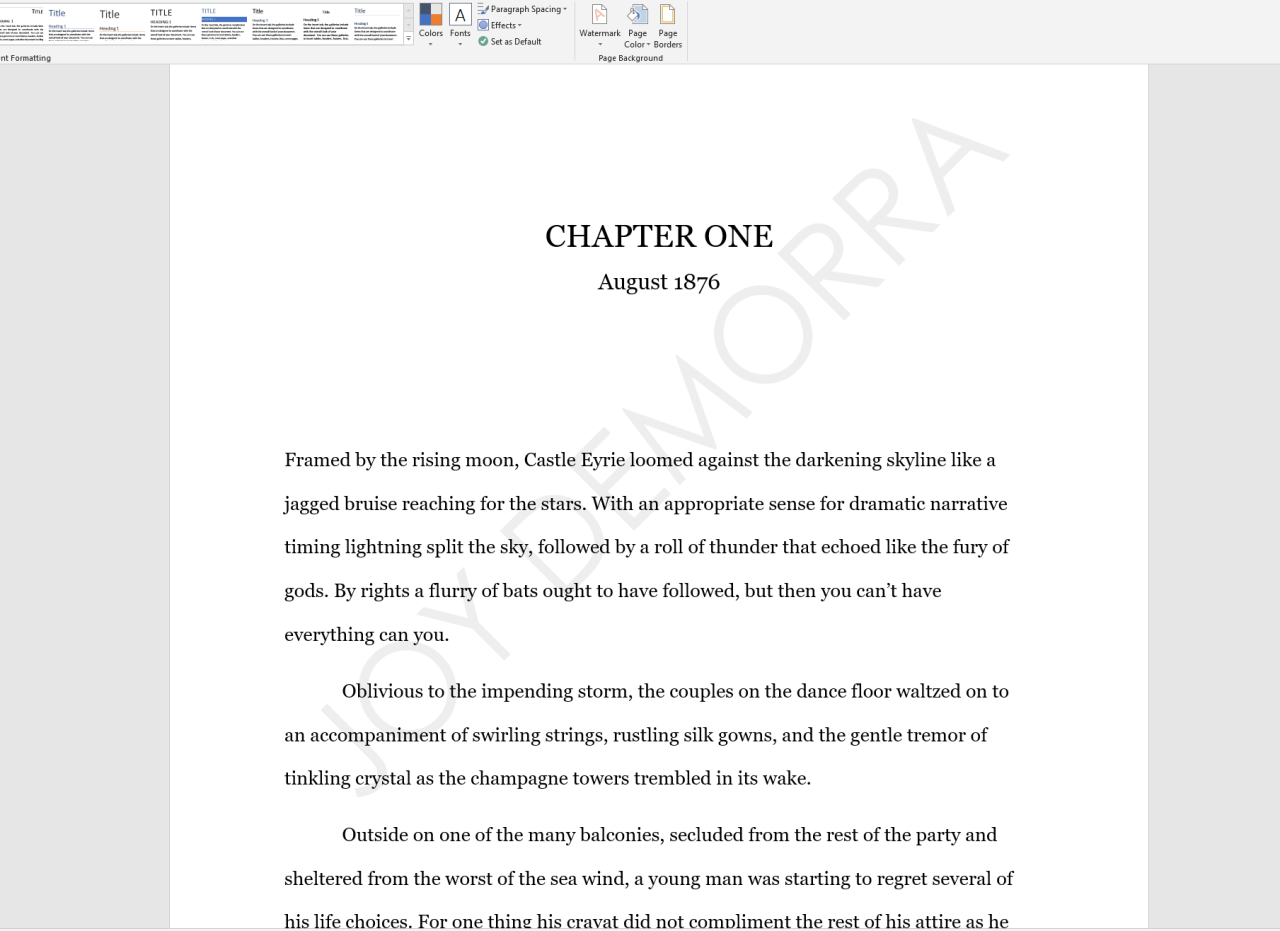
And it’s been brought to my attention in answering lots of questions about eye health and managing my symptoms, that some of you are not aware that Word doesn’t have to be like this, when it can in fact be like this:
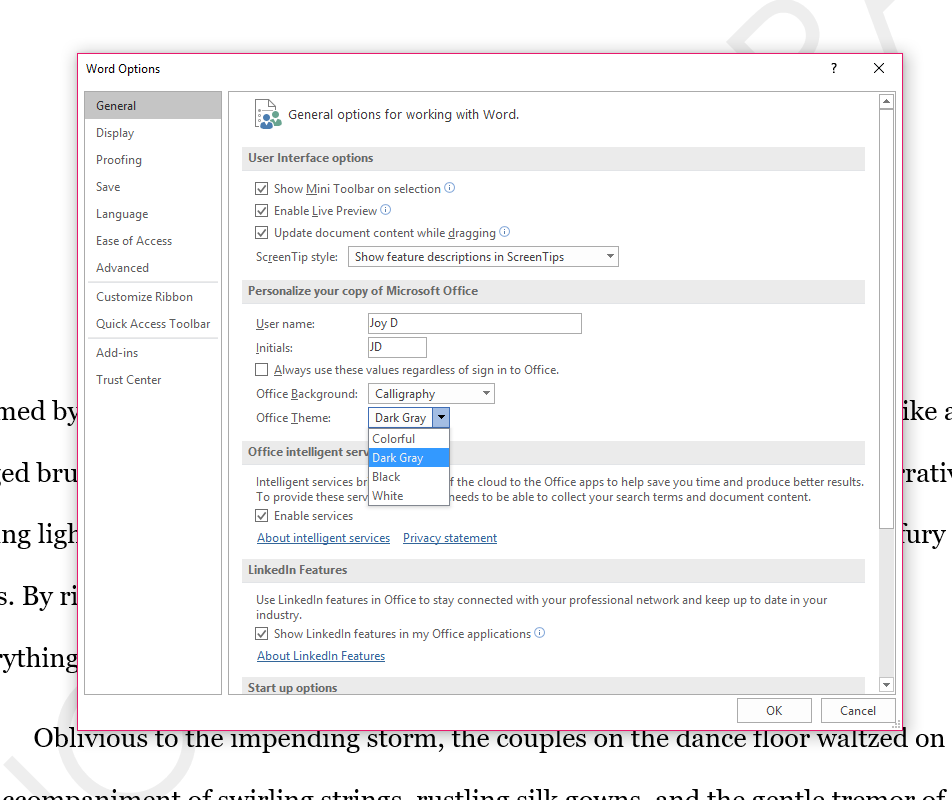
And it is so much better for you. I mean it doesn’t have to be this specific color setting, you can play around with it and find the color setting that doesn’t hurt your eyes or trigger migraines/makes it easier for you to read and follow text, but I have found dark grey and blues to be what works best for me, and the way you change these settings is to first of all go into File > Options > General and then changing the Word theme from “Colorful” to “Dark Grey”
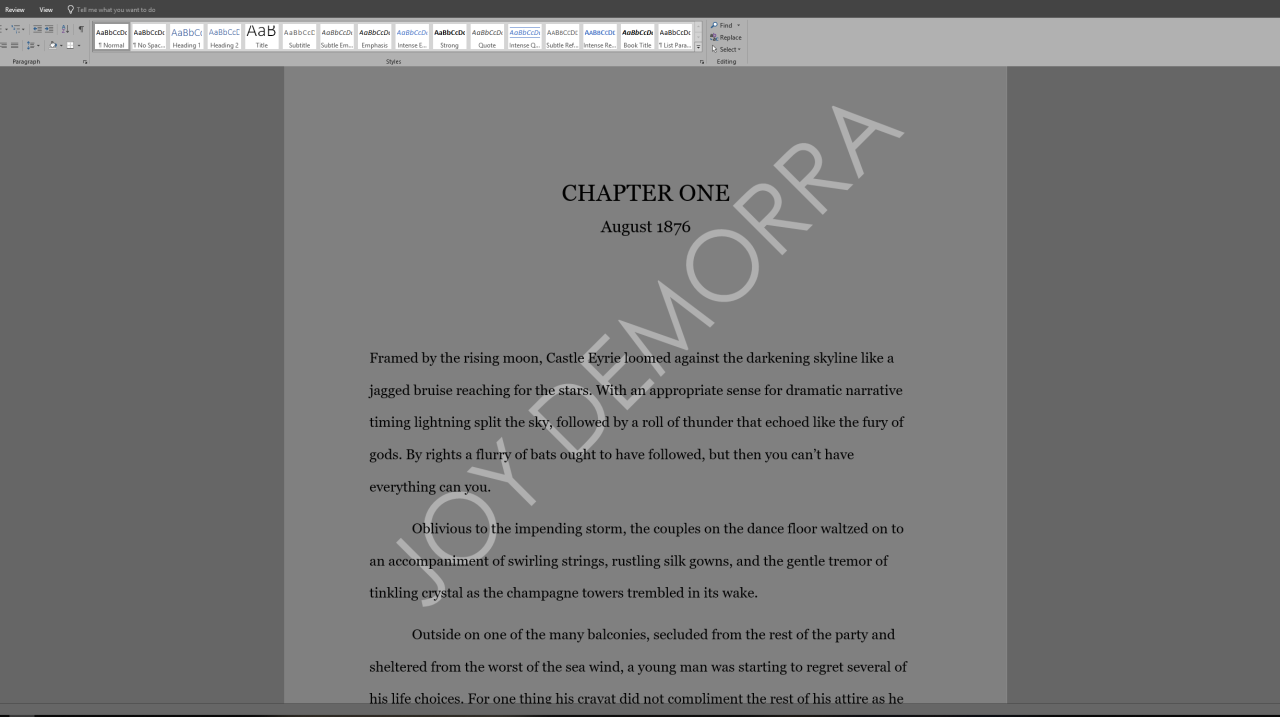
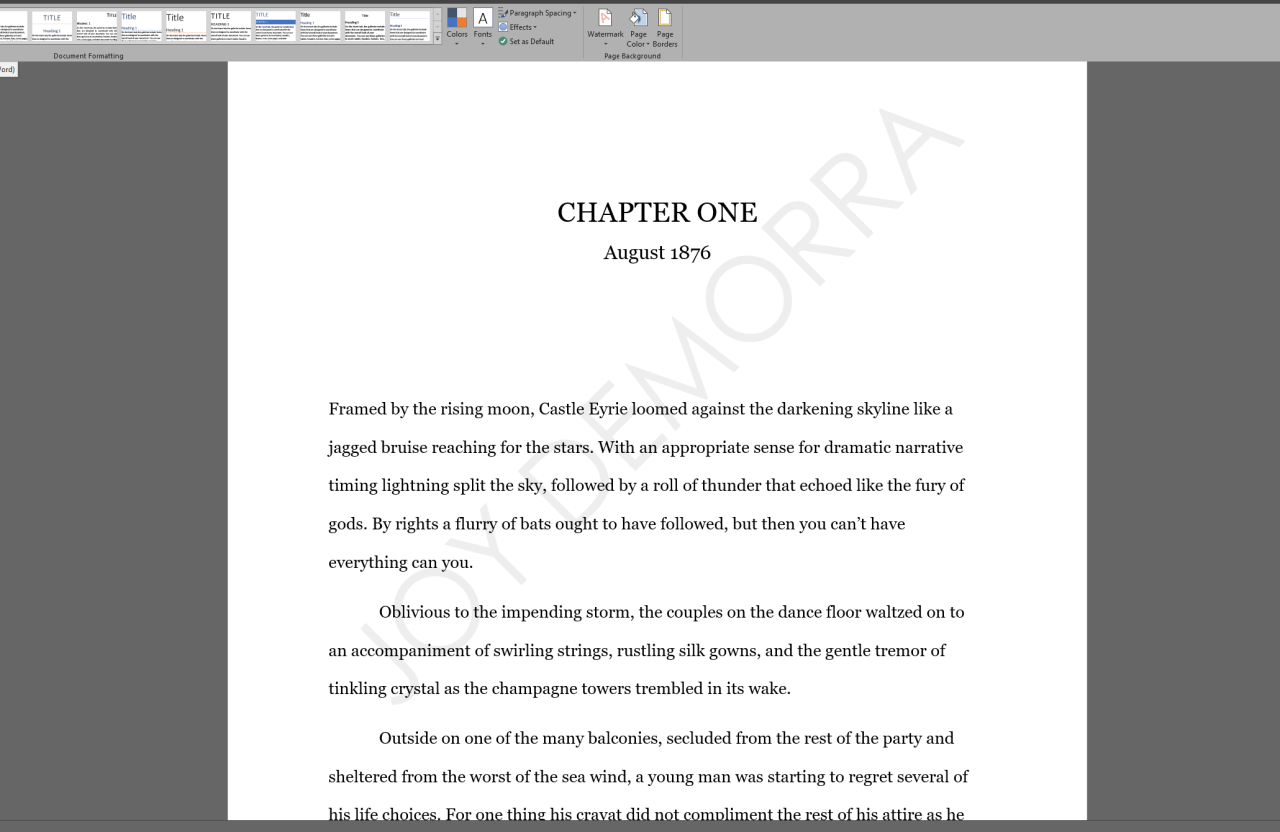
Which will give you this look:
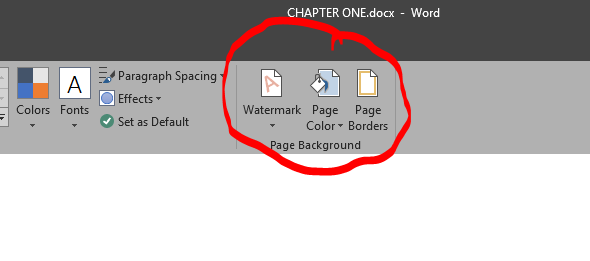
And for some people that will be enough of a reduction in white screen to help with eyestrain and other problems, but if you are like me and the bright white is just playing havoc with your vision/processing, you can go up to the Design tab (it’s between Insert and Layout usually) and change the color of the text file page:
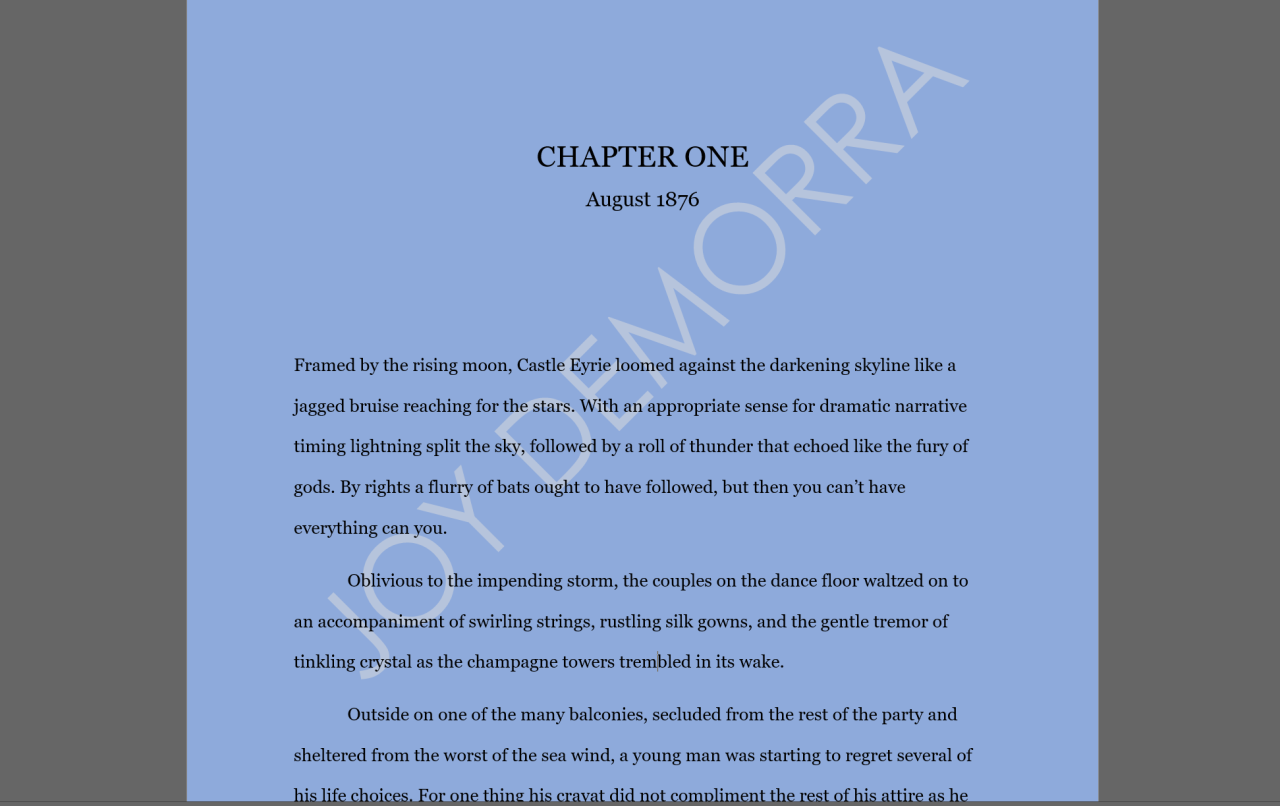
Like so:
Like I said, dark greys and blues work best for me, and this is what manuscripts look like when I am reading them for work, but you can totally play around with it and find what works for you, and hopefully help yourself avoid some of that “oh god my eyes feeling” that happens from staring at the blank white page for hours on end before you alt out the tab and pull up tumblr instead.
Anyway, hope that helps some of you? Good luck? Don’t hurt yourselves unnecessarily? Go take a break from your screen right now and get something to drink? idk, just take care. You deserve to.






 EquusGirl's Tumblr